The final service is part of the production system
How a daily email became a regeneration standard, then the execution system around it.
A production system can be technically correct and still fail at regeneration, assembly or final service.
Sec. 01
Context and operating scale
Central production only succeeds if food is regenerated, assembled and served correctly at the final location.
The highest risk usually sits in the last part of the chain: unclear reheat instructions, inconsistent equipment, timing differences, missing batch status, variable assembly, knowledge held by experienced individuals, and unclear corrective action.
None of this arrived as a finished system. It developed over roughly a year inside the VUW contract, from a daily email into a structured classification grid and a parallel standards layer. That is the period during which the two Star Awards in 2024 and promotion to Culinary Development Lead followed. The four stages below trace the development, ending with how it travelled once the role expanded beyond one contract.
Sec. 02
The real problem
Production documentation frequently describes what was made. It rarely describes what the receiving team must do next.
That gap is where a technically correct system quietly fails.
- Which batch is this?
- What condition should it arrive in?
- How is it stored?
- What equipment is used?
- What temperature and time apply?
- What visual or sensory cue confirms success?
- How is it held, and how is it assembled?
- What happens when the result is wrong, and who records completion?
Sec. 03
My role
- Developed practical regeneration and assembly guidance
- Connected central production records to the receiving teams
- Defined batch identity and status conventions
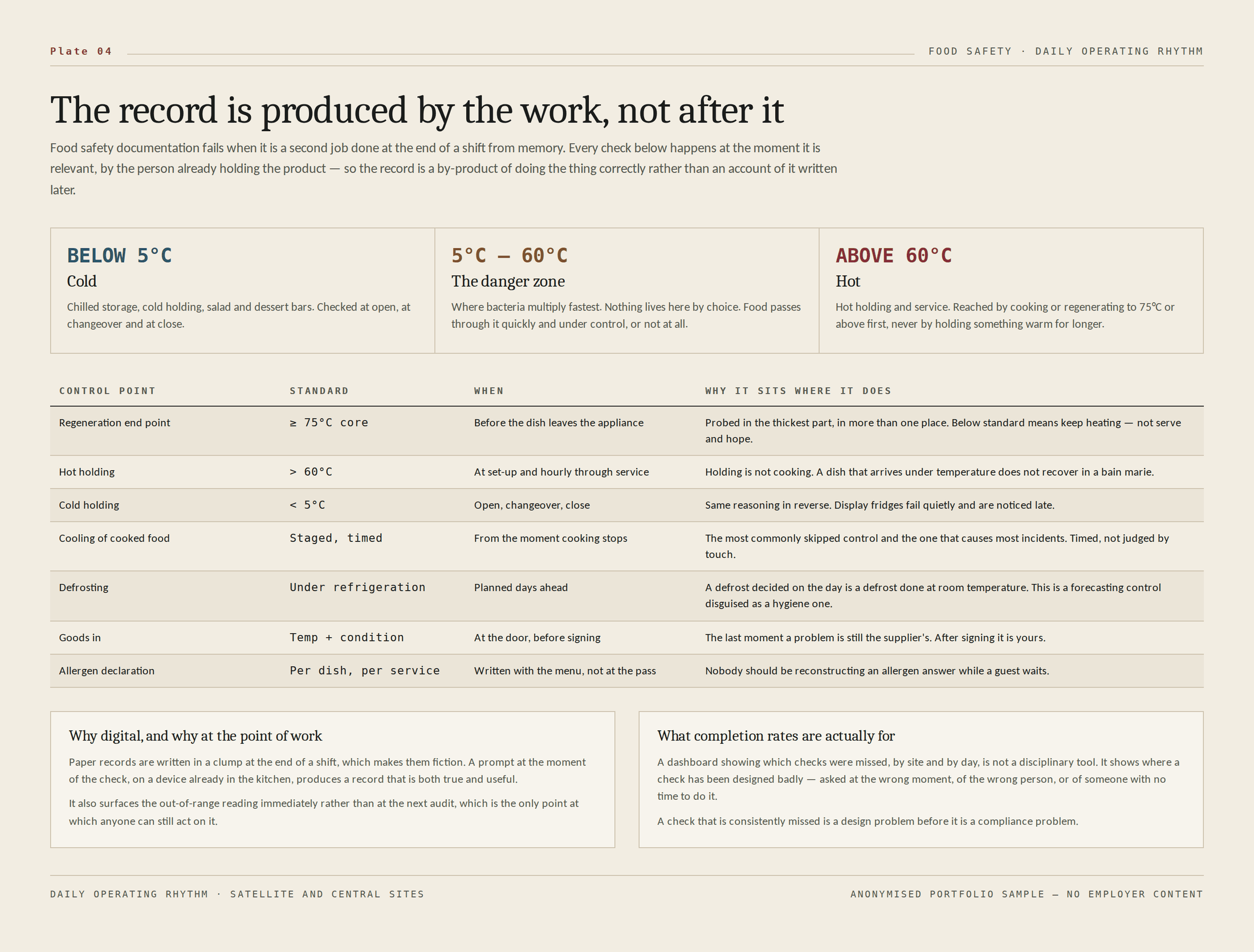
- Built temperature and compliance recording into the working sequence
- Produced training and onboarding material around the guidance
Sec. 04
What I designed
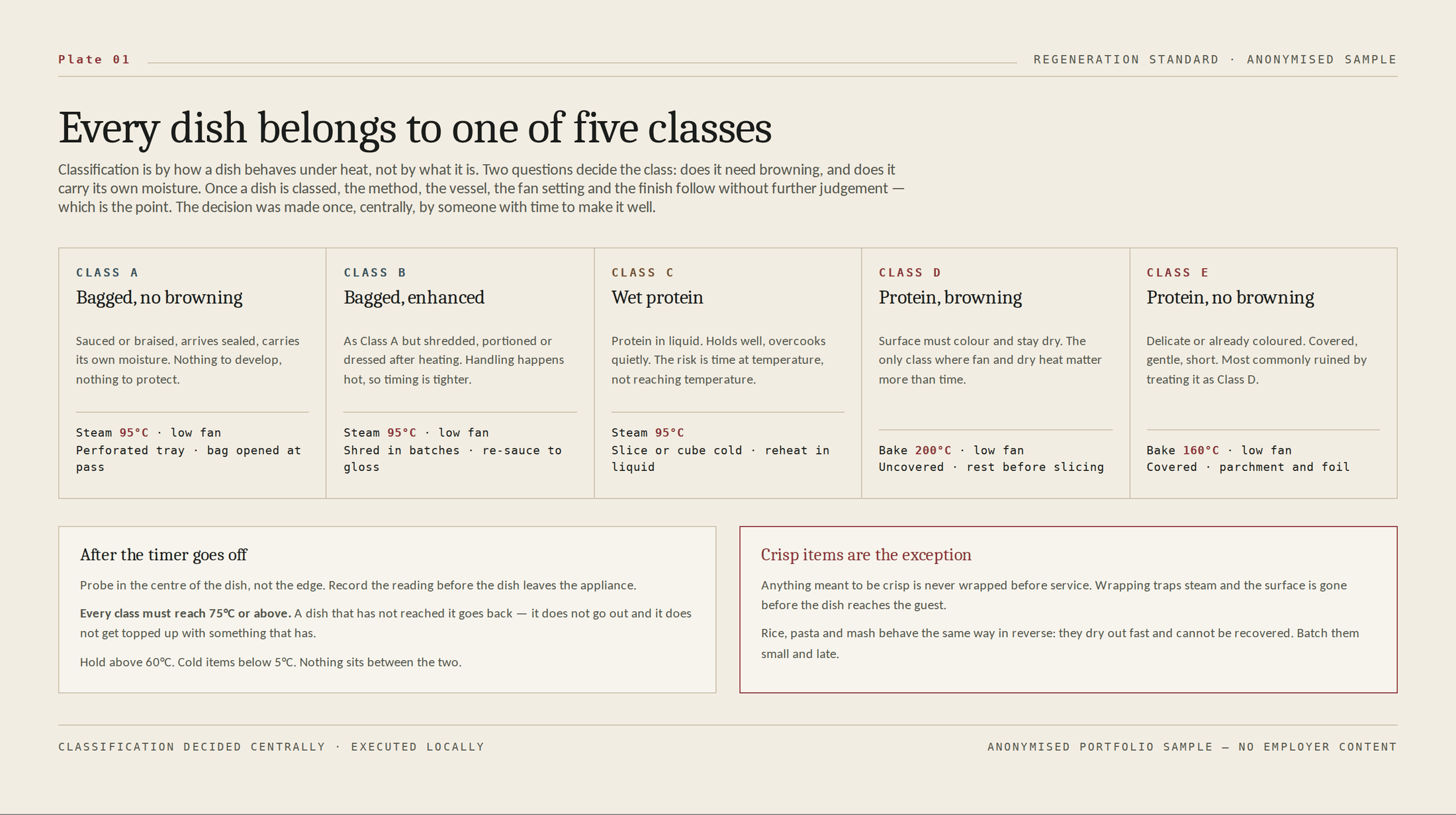
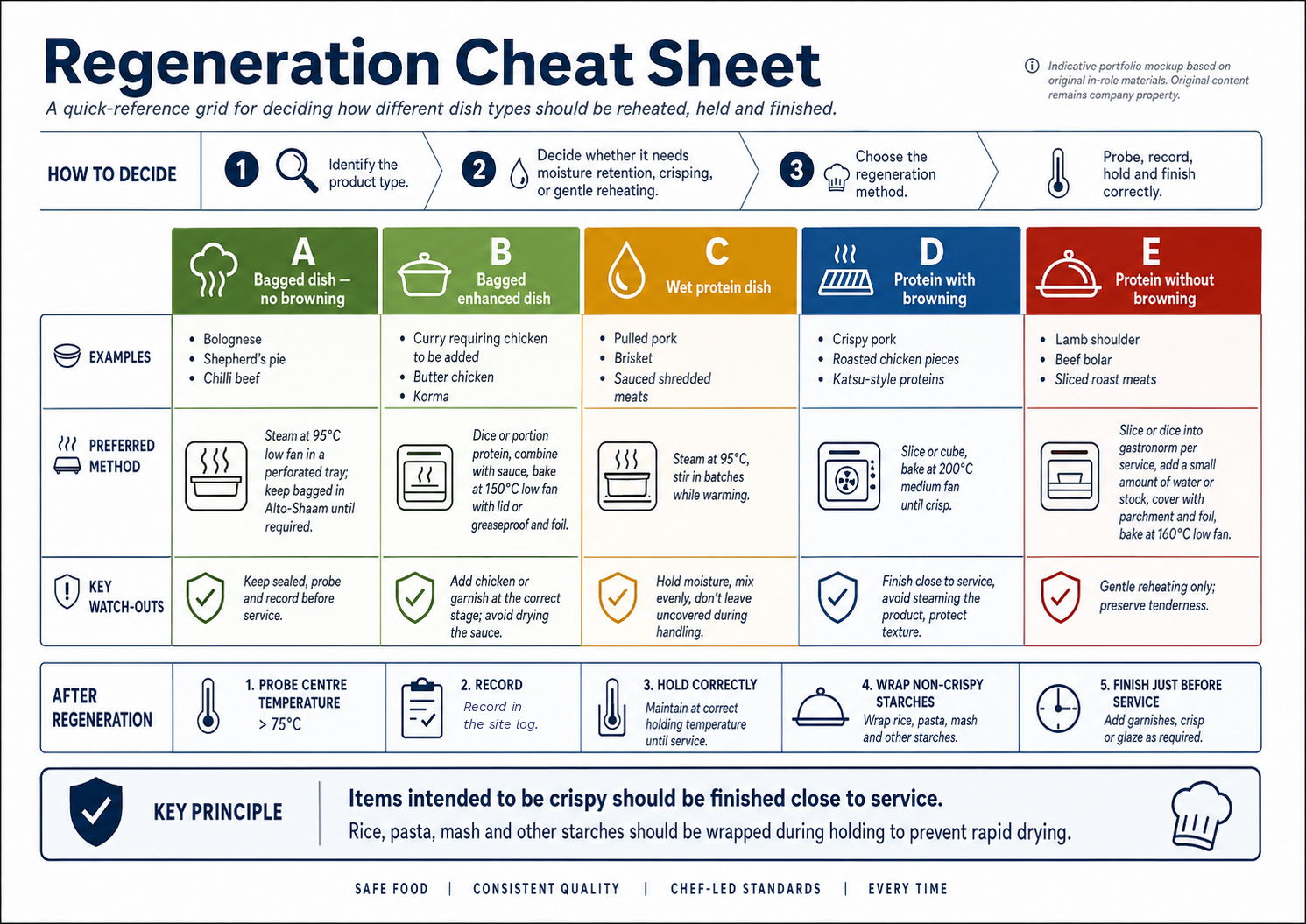
The framework organises the last part of the chain into fourteen working components, grouped into the six connected layers shown above. Each component answers a question a person actually asks mid-service.
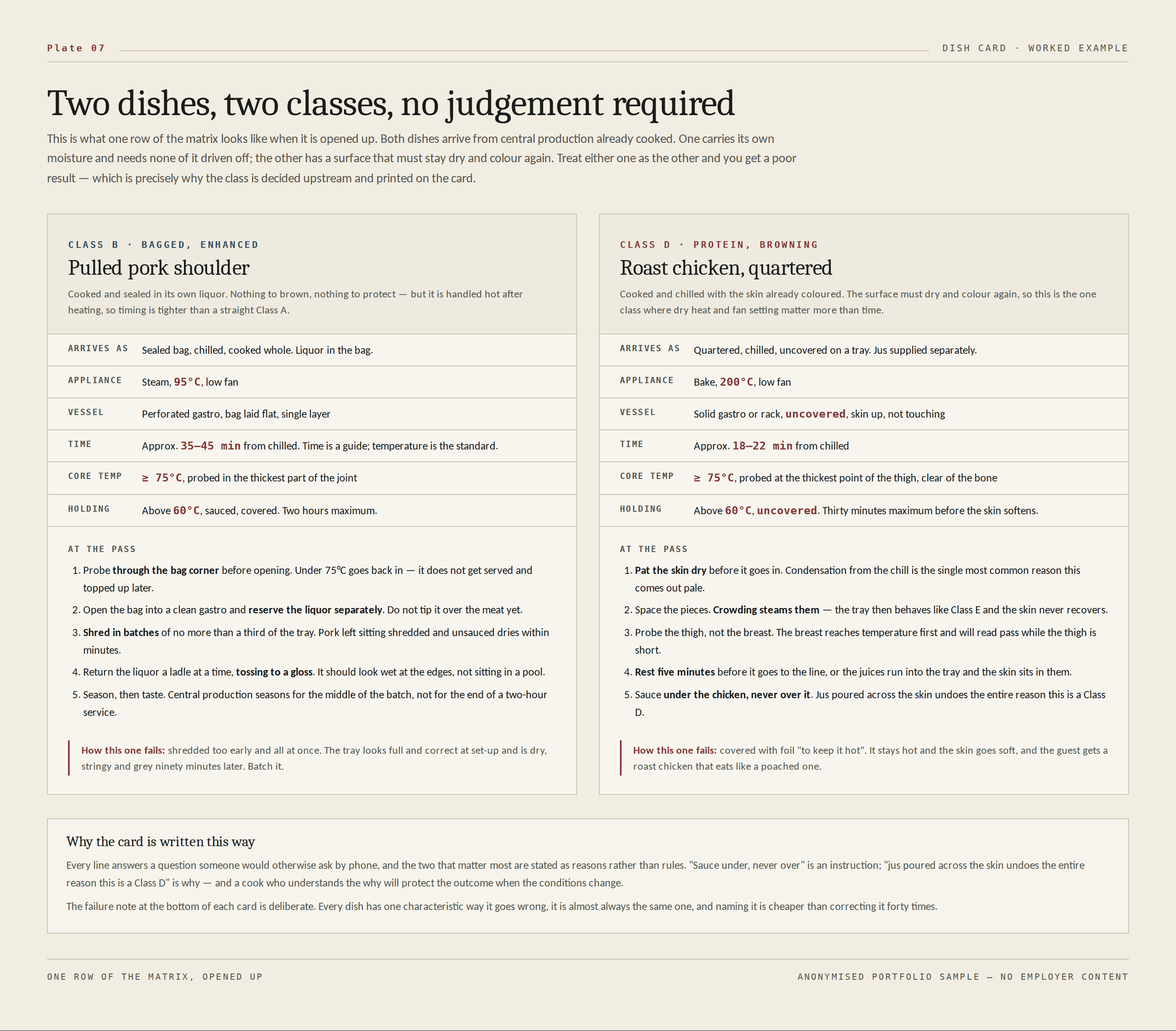
The organising decision was to classify dishes by behaviour rather than by category. A braised beef and a lentil dhal have nothing culinarily in common and behave identically under heat; a roast chicken and a poached salmon are both protein and behave nothing alike.
So category was abandoned. Two questions decide the class and nothing else does, which is why several hundred dishes collapse to five classes a person can hold in their head. The questions are asked once, upstream, by whoever develops and releases the dish. What reaches the receiving site is the answer, not the questions.
- Regeneration standards — five classes decided by two questions, browning and moisture
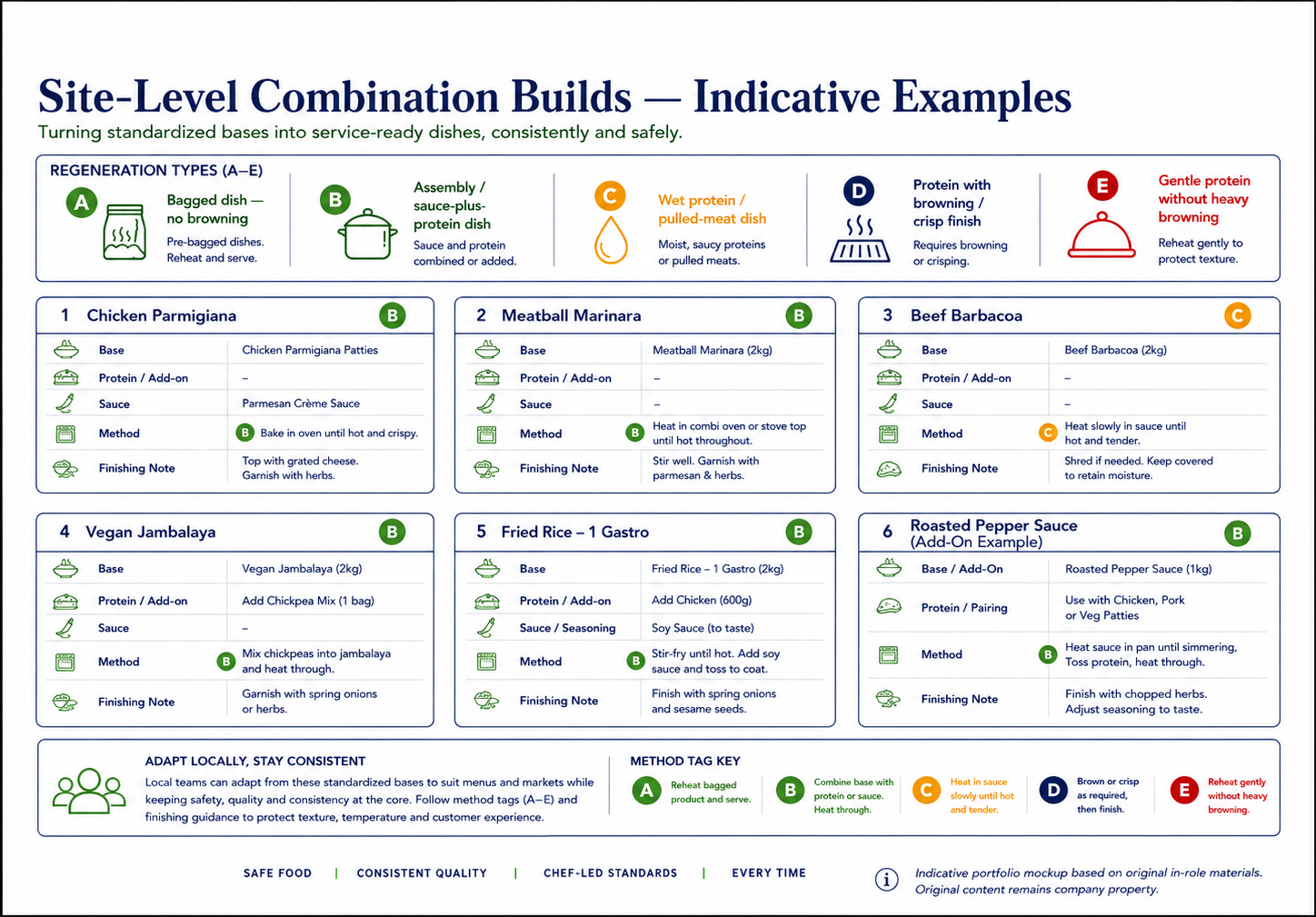
- Dish matrix — one row per dish, one answer per column
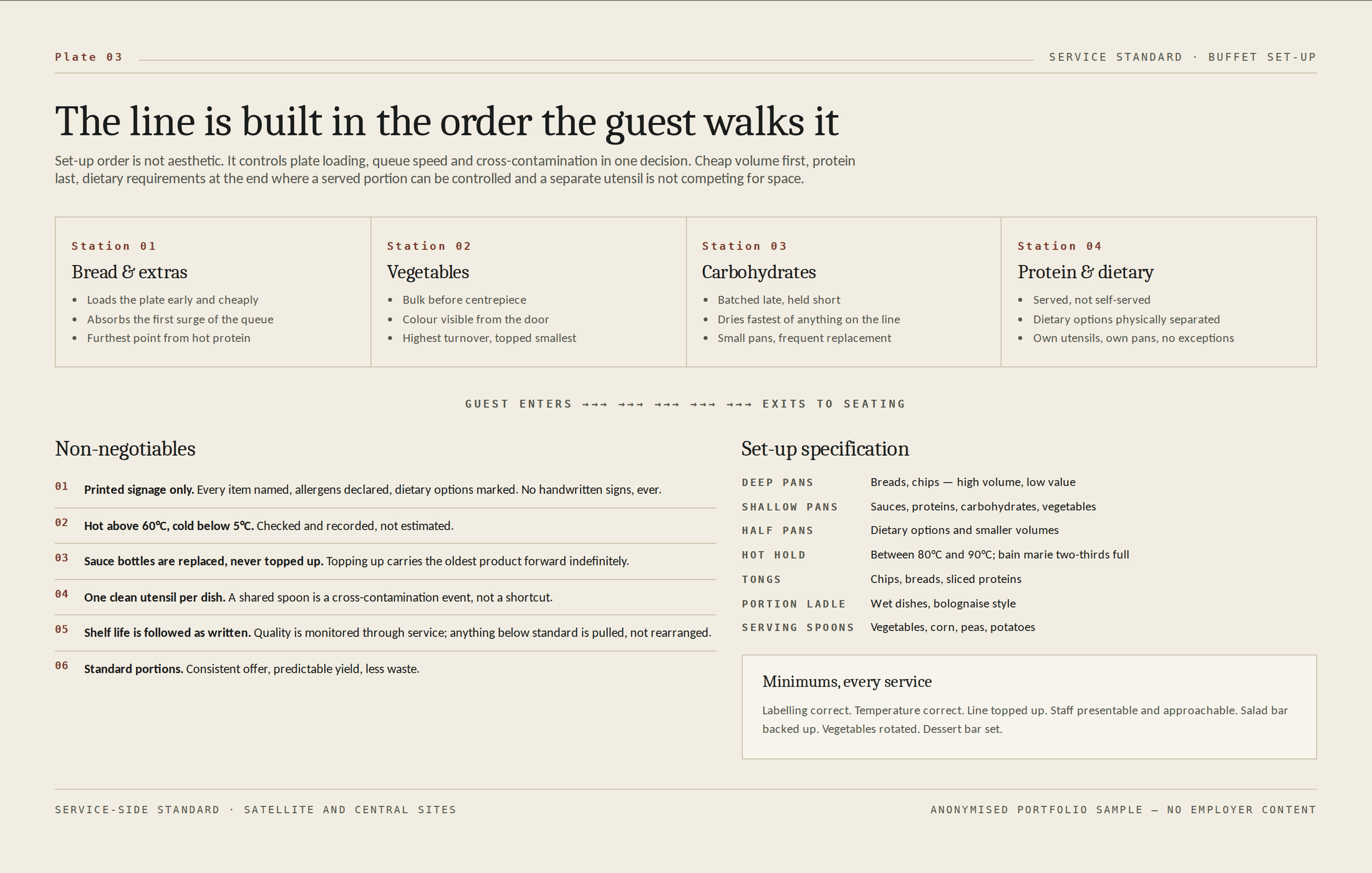
- Assembly and buffet set-up specifications
- Batch identity and status
- Temperature and compliance recording built into the working sequence
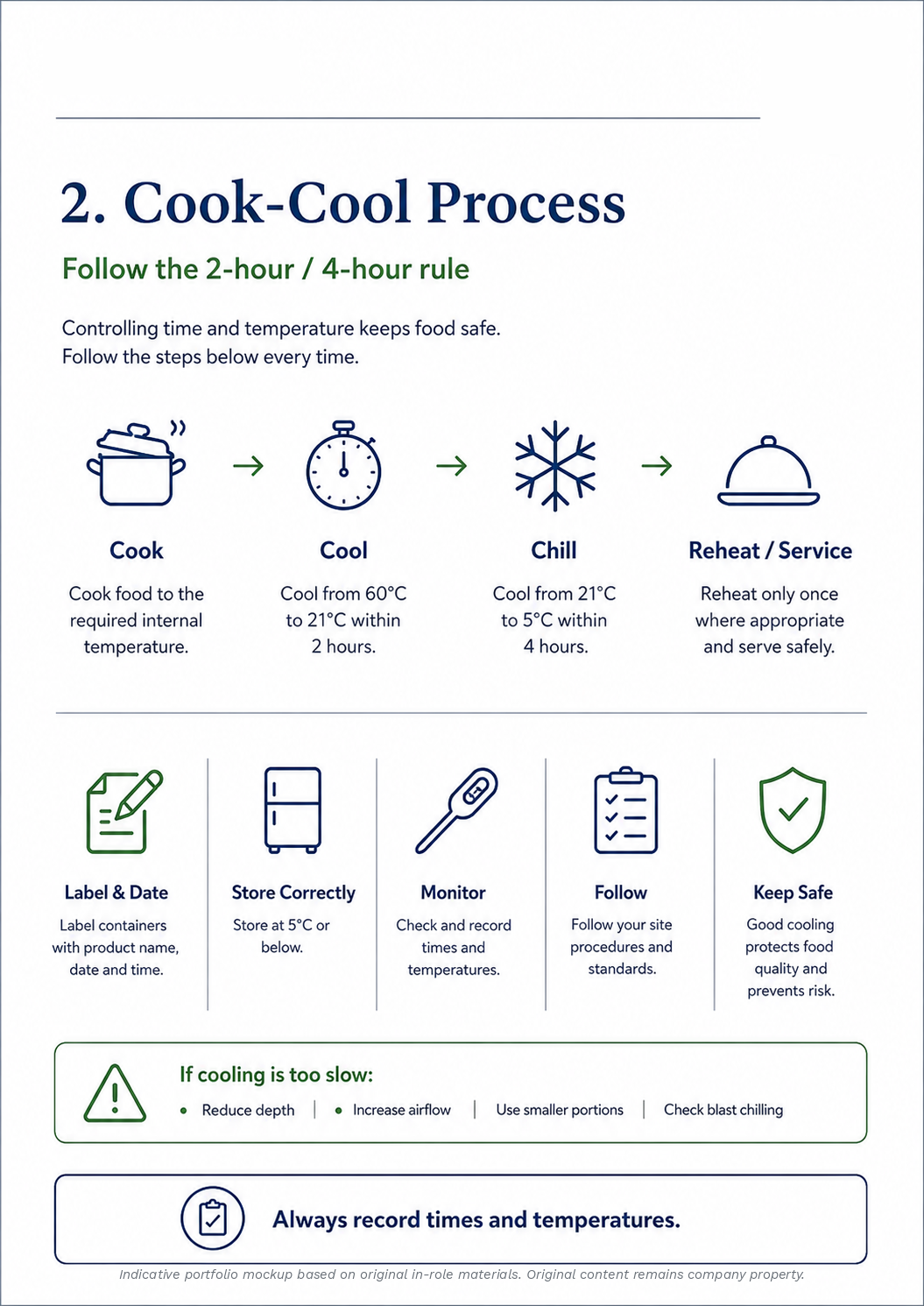
- Cook-cool and reheat control — the two-hour and four-hour rule as a working sequence rather than a policy reference, with the corrective action stated where cooling runs slow
- Goods receiving and storage standards by category, with rejection criteria and the checks made at the point of delivery
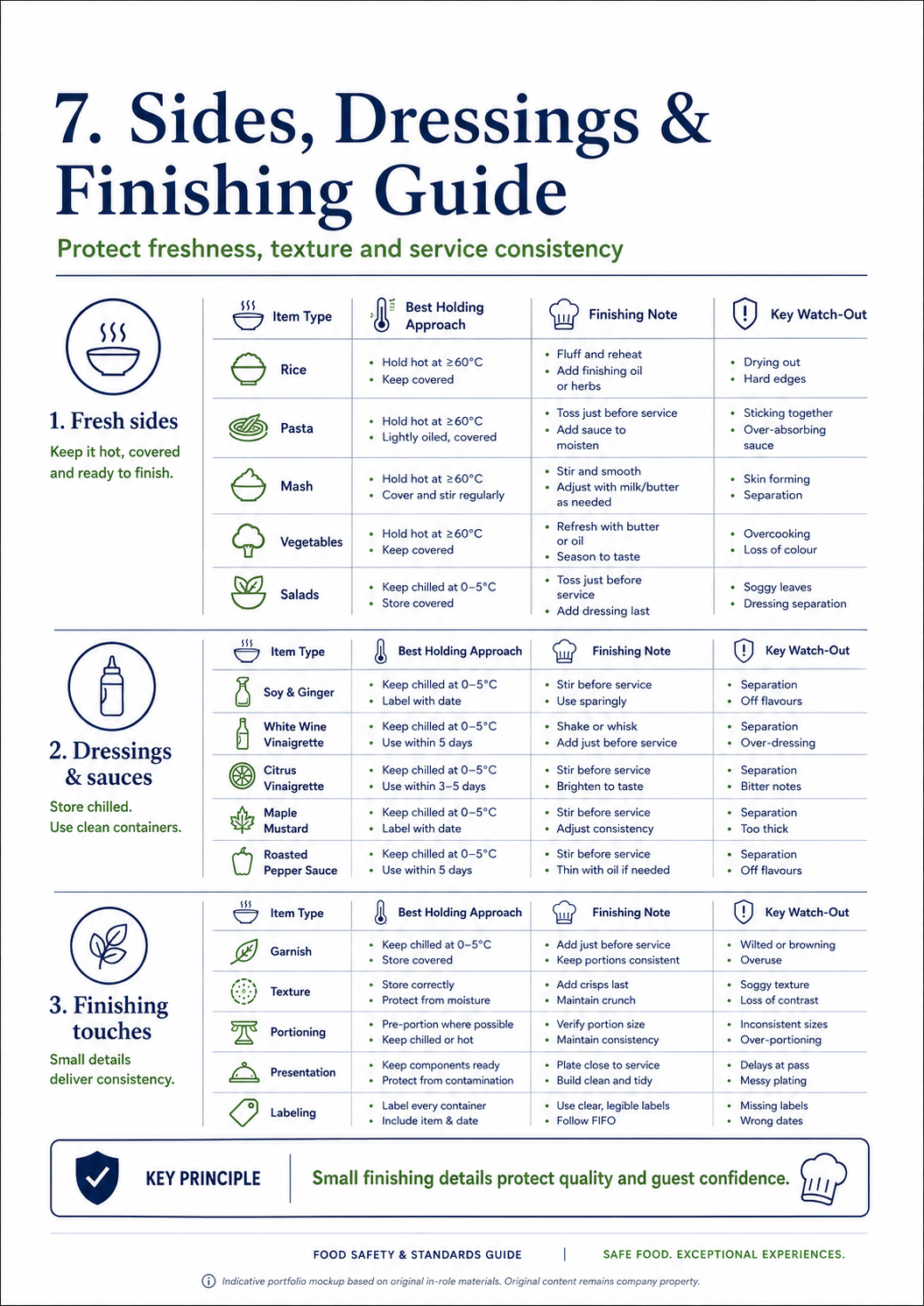
- Salad, side and dressing standards — holding approach, finishing note and the characteristic failure for each item type
- Supervisor audit tools, framed to coach and verify rather than to catch
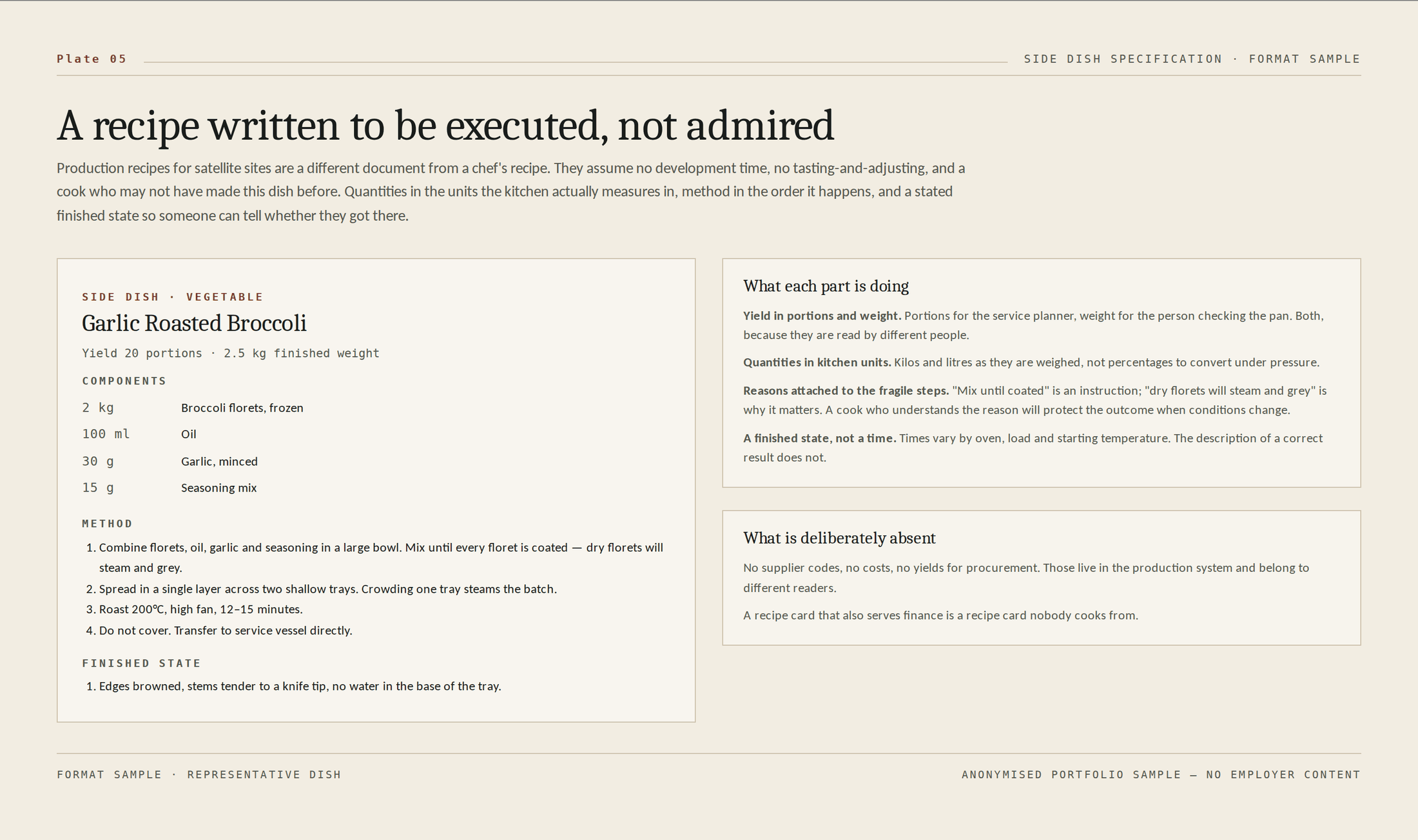
- Production recipes written for execution rather than development
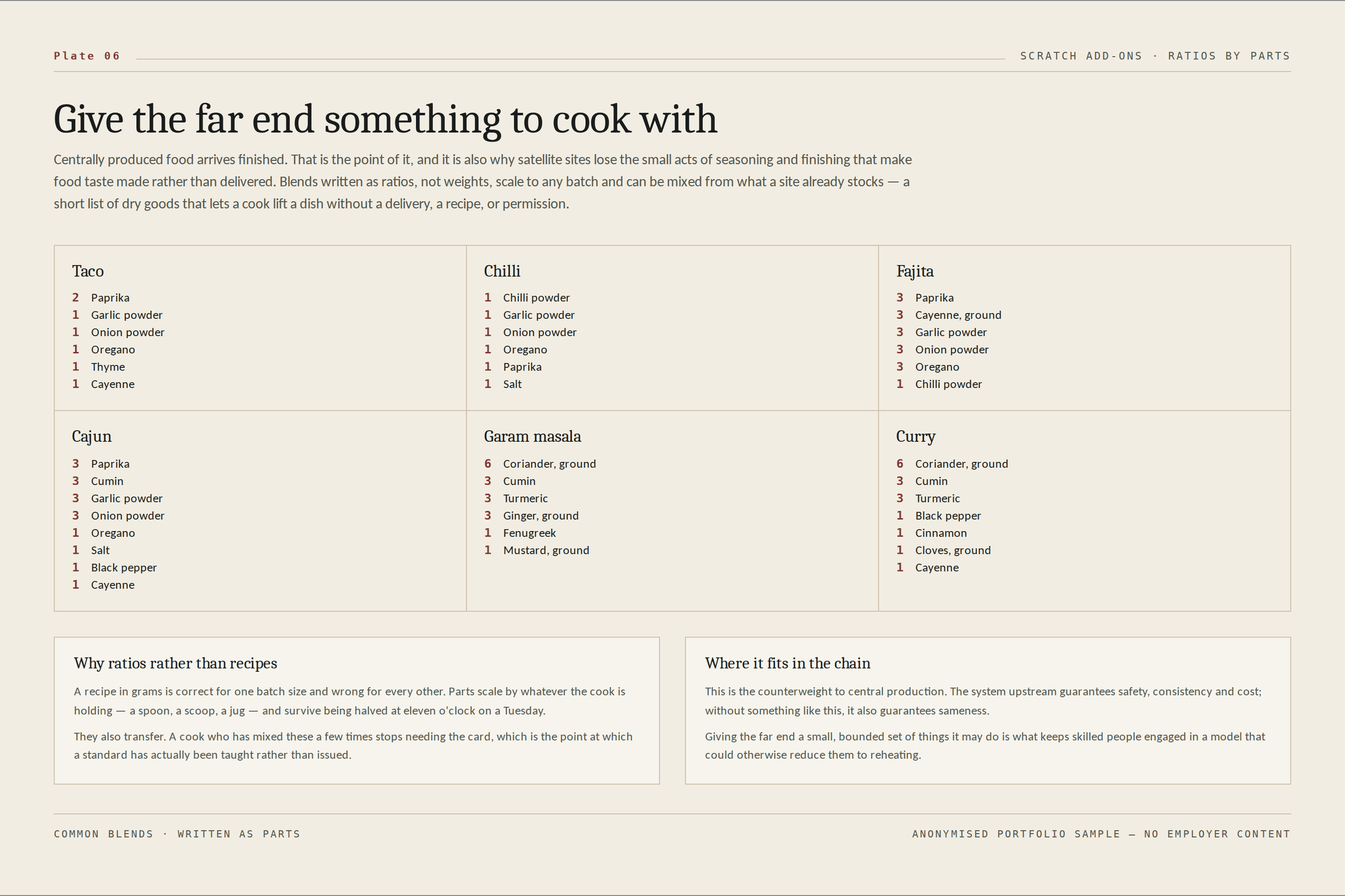
- Scratch add-ons so the far end can still season and finish
- Role ownership, corrective action and change control
- Training and onboarding around all of it
- Per-site specification: level of detail, vocabulary, visual identity and equipment named to match the operation
The daily email
How do you stop the same reheat question landing on the pass every day?
The system did not start as a system. It started as a daily email to the teams receiving centrally produced food: what today's dishes were, how to bring them back correctly, what to watch for. No matrix, no classification — just repeated, plain instruction, written because the same questions kept arriving by phone.
- What it proved
- The questions were repetitive and answerable in advance. Writing the answer once, before service, was cheaper than fielding it once per site, per shift.
- What was still limited
- An email is not a reference. It could not be searched mid-service, did not accumulate into anything a new starter could be handed, and had to be rewritten from nothing the next day.
The grid
Can several hundred dishes be reduced to a small number of rules a person can hold in their head?
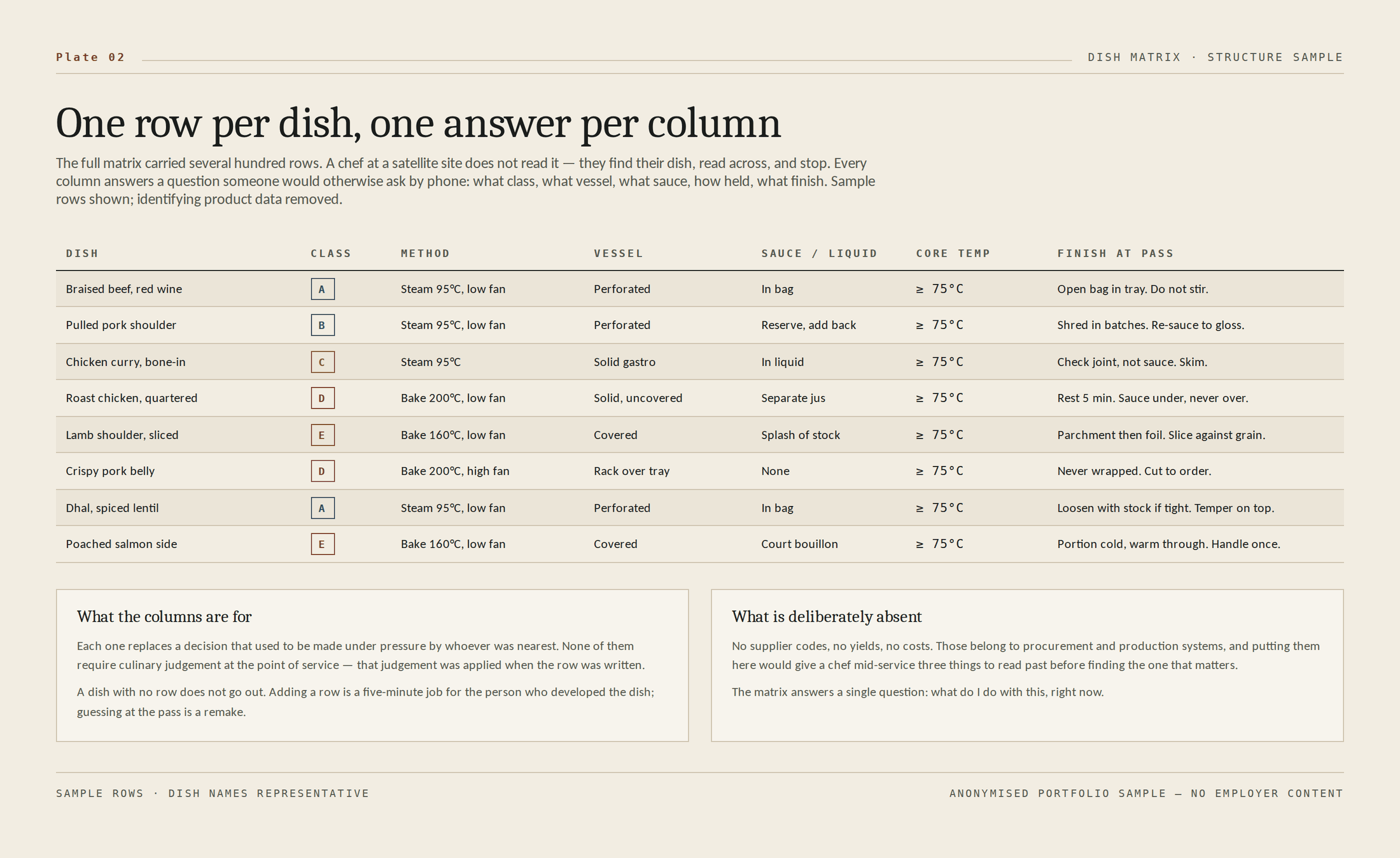
The daily notes were replaced by a standing structure. Two questions were asked of every dish — does it need browning, and does it carry its own moisture — and the answers decided its class. Nothing else was asked. That reduced several hundred dishes to five classes, each with a fixed method, vessel and finish. Crucially the asking happens once, at development, not at the pass: a dish nobody has classified yet gets classified before it is released, never improvised during service.
- What it proved
- Classifying by behaviour rather than category was the right cut. A stew and a dhal behave identically under heat and belong in the same class; two proteins can behave nothing alike and belong in different ones. And because the cut is that simple, a new dish can be placed in the minutes before release rather than argued about in service.
- What was still limited
- The grid solved reheating. It said nothing about what happened either side of it — how the buffet was set up, how service held the line, what got audited and recorded.
The standards layer, built in parallel
Once a dish is regenerated correctly, is the risk actually closed?
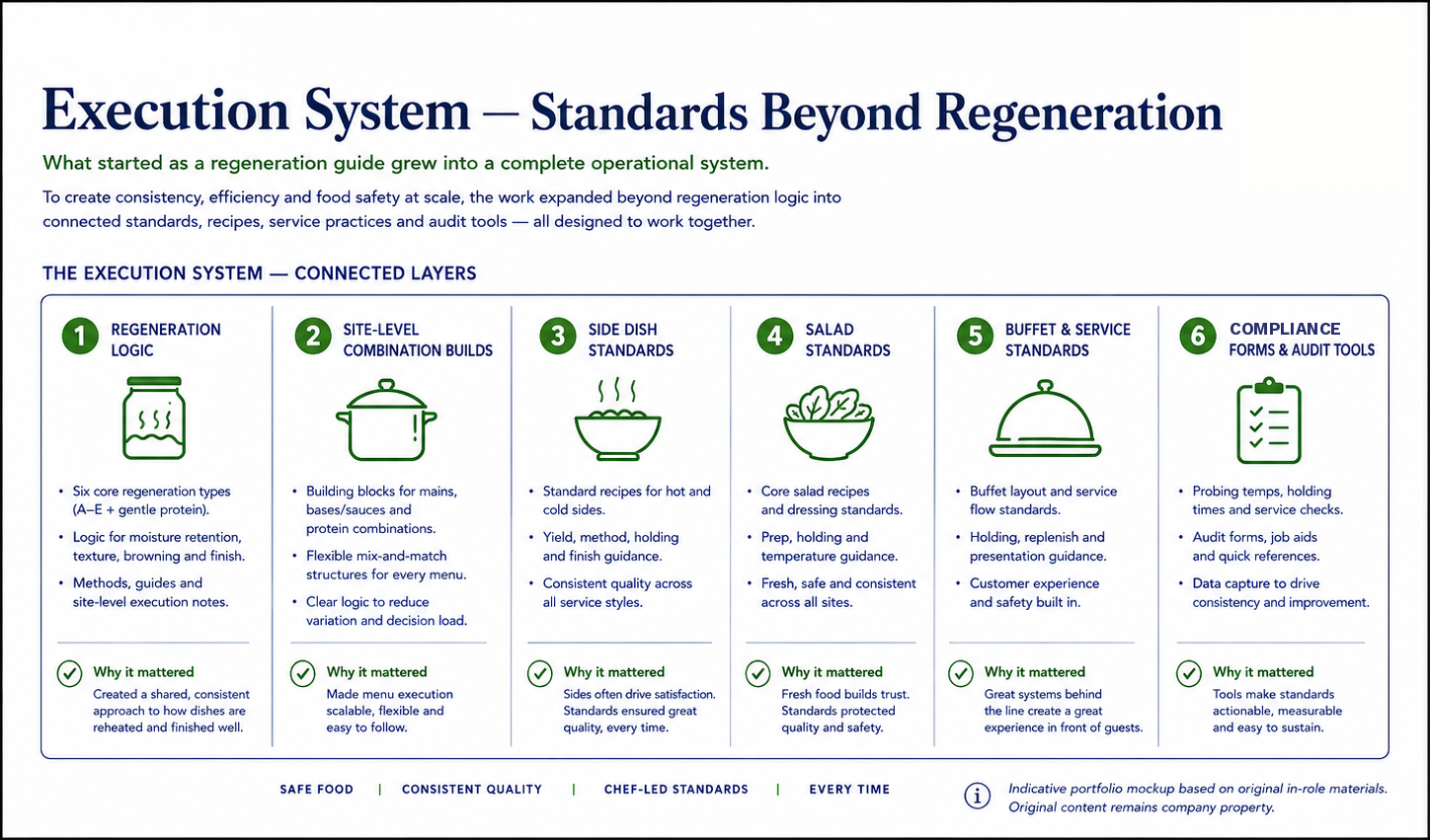
Alongside the regeneration grid, a separate but connected body of work developed the standards either side of it: buffet set-up and service-line sequencing, supervisor audit tools, and the compliance forms and guides built through SafeFoodPro. This was different work from the execution logic of the grid — the grid says how to reheat a dish, this layer says how it is displayed, served, checked and recorded.
- What it proved
- Reheating correctly is necessary but not sufficient. Most of the remaining risk sat either side of it, in service and in the record left behind, not in the regeneration step itself.
- What was still limited
- Both layers were still specific to the VUW operation and its three production kitchens. Neither had yet been tested anywhere that didn't have that infrastructure.
Sector rollout, by decomposition
Does the same system travel to a site that doesn't have VUW's production kitchens or van network?
After the move to Culinary Development Lead, the work travelled — but not as a single package. The centralised three-kitchen production model was VUW-specific and stayed there. What moved independently were the components that didn't depend on it: the SafeFoodPro standards, the buffet and service guides, and the regeneration classification logic itself, each adapted to the receiving site's own kitchen, equipment and staffing rather than issued unchanged. Forsyth Barr Stadium ran its own separate track throughout and is not part of this rollout.
- What it proved
- A system built for one contract can outlive it, provided the transferable parts are separated from the infrastructure that only existed there. Sites did not need the production kitchens to benefit from the standards.
- What it made me ask next
- How much of a standard should be spelled out versus assumed, given how different the receiving sites' equipment, turnover and experience mix actually are — covered in the specification section below.
Sec. 05
How it was used
The guidance was written to be read under pressure, by the person holding the tray, at the moment the decision is made — not filed for an audit that happens later.
Where evidence of scope, adoption and results is still being gathered, this page says so rather than implying a result.
Sec. 05b
Why the decision moved upstream
At the pass, under pressure, with a queue forming, nobody makes a good decision about fan settings. So the decision was moved to where there was time to make it well: once, centrally, by the person who developed the dish.
What arrives at the satellite site is not guidance to interpret. It is an answer to read. That distinction is the whole design — a document that requires judgement at the point of service has simply relocated the problem rather than solved it.
It also sets a hard rule that a dish with no row does not go out. Adding a row takes five minutes for the person who built the dish. Guessing at the pass costs a remake, and sometimes a complaint.
Sec. 05c
Specified to the site, not issued to it
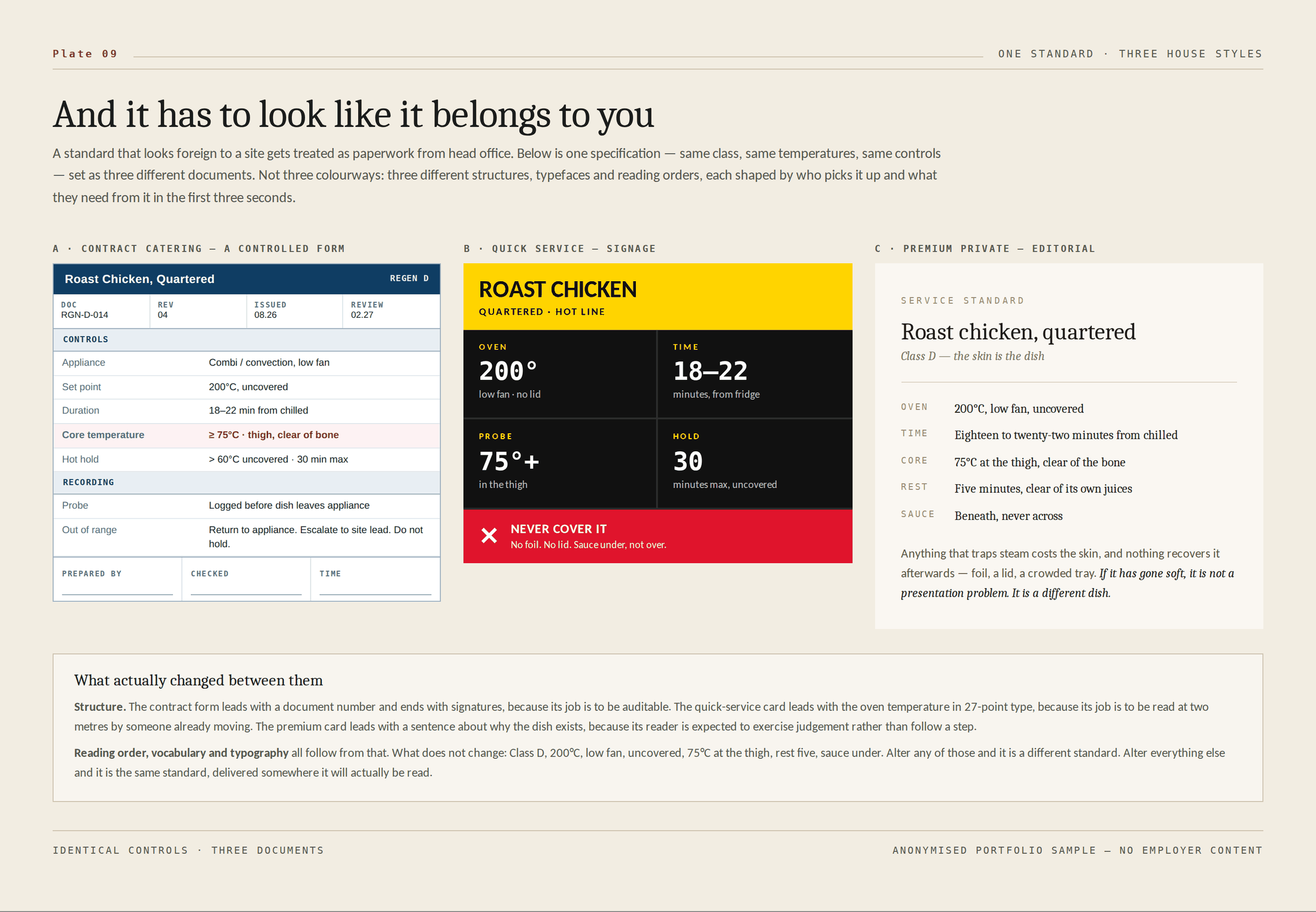
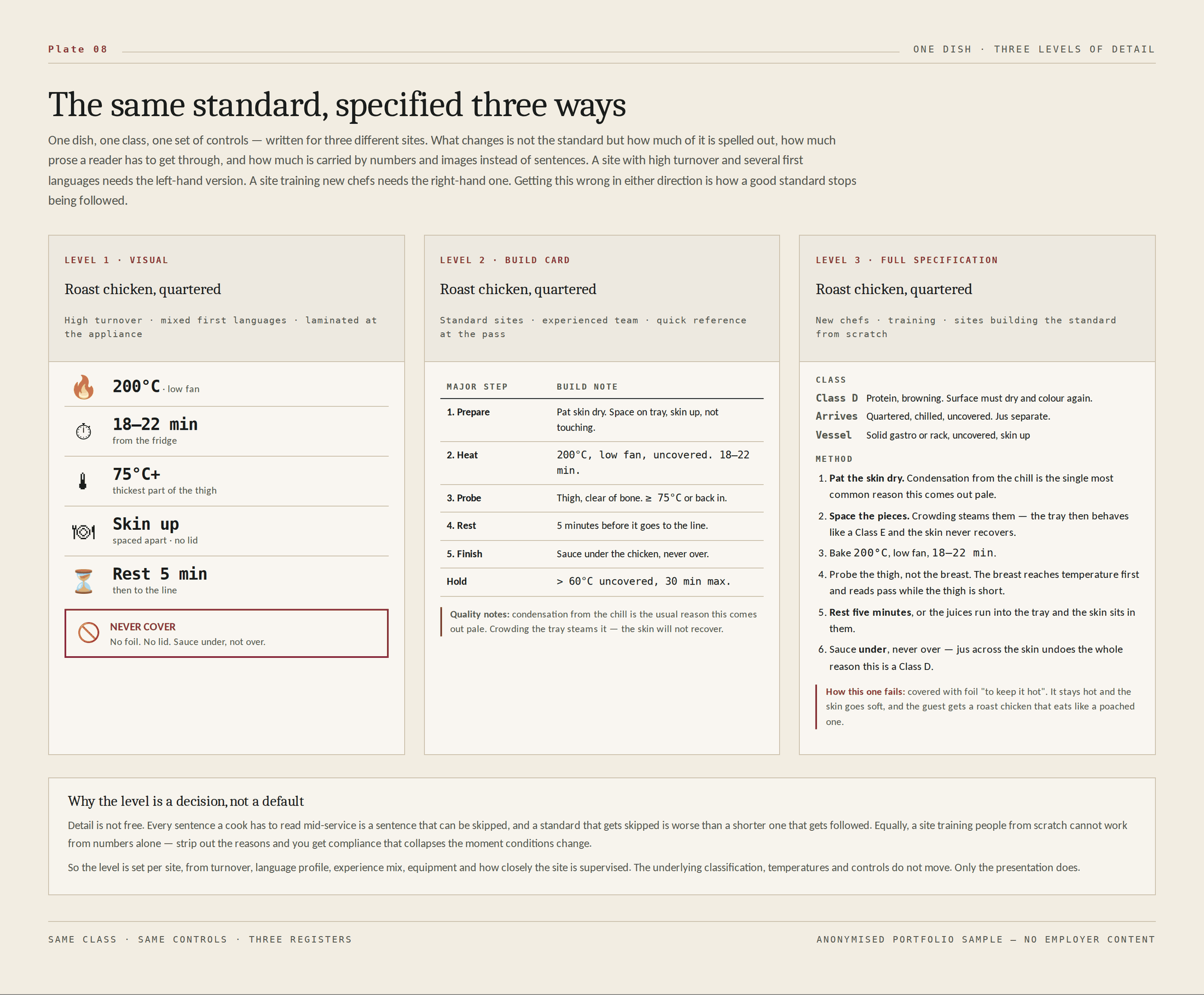
A standard is only as good as the reading of it. The classification, the temperatures and the controls are fixed — but how much is spelled out, how much is carried by numbers and images rather than sentences, and what the document looks like are all decisions made per site.
Level of detail is set from turnover, language profile, experience mix, equipment and how closely the site is supervised. A high-turnover site with several first languages needs icons, large numerals and one prohibition. A site training chefs from scratch needs the reasons, because compliance without understanding collapses the moment conditions change. Both are the same standard.
Visual identity matters more than it should. A document that looks foreign to a site gets treated as paperwork from head office and quietly ignored. Setting the same specification in the operation's own language, typography and colour is the cheapest thing you can do to make it get used.
Equipment is the other variable. A combi, a conventional oven with a weak fan and a hot-hold cabinet all reach the same core temperature by different routes, and a standard that names an appliance the site does not have is a standard that will be improvised around.
The range runs further than most people expect. At one end a full production specification: equipment checked before the first pan is touched, mise en place, allergens, yield, corrective action and a sign-off. At the other, a strip on the appliance door carrying five numbers and one prohibition. Most sites need both — the spec is the record and the training tool, the strip is what gets read at the pass — and both carry the same revision number so anyone can tell whether the door label is current.
Sec. 06
The standards, and the thinking behind them
The originals are the employer's property and are not reproduced. Everything below is indicative — rebuilt samples preserving structure and reasoning, with employer systems, internal recipe codes, supplier data and client references removed. They fall into two kinds, and the difference in how they look is the point rather than an accident.
The standards as the teams received them
Reference documents issued to kitchen teams across the contract and later the sector. They look like compliance documents because that is what survives in a working kitchen and what an HSEQ team will sign off — the register is chosen for the reader, not for the portfolio.
The reasoning, set out
The same system explained rather than issued: why each decision was made, what it replaced, and where it would fail. These were built for this portfolio, in the site's own typography — they are an argument, not a document anyone worked from.
Sec. 07
Relevance by outcome
Financial relevance
- Reduced remakes
- Less overproduction
- More predictable labour
- Lower waste
- Better use of centrally produced food
Compliance relevance
- Clearer time and temperature controls
- Traceable batch completion
- Visible corrective action
- More consistent documentation
Employee relevance
- Fewer repeated questions
- Reduced uncertainty
- Clearer handovers and faster onboarding
- Less friction caused by conflicting instructions
Customer relevance
- More consistent final presentation
- Fewer service delays
- Better product quality at the point of service
Sec. 08
Evidence ledger
Each statement on this page sits at one of five levels. Measured means recorded and quantified at the time. Documented means a retained artefact or record exists. First-person account means it rests on Ciarán's own testimony with no external corroboration. Inferred means it is reasoned from the design rather than shown by data. Not claimed means the page is explicitly not asserting it, and says why. Nothing is published above the level its evidence supports.
Regeneration and assembly guidance was developed and used across the seven halls of residence operation.
The five-class structure, the dish matrix and the buffet set-up standard shown in the samples.
Samples rebuilt from the originals. Structure and logic preserved; employer content removed.
The design reasoning behind classifying by behaviour rather than category.
The system originated as a daily email to receiving sites before it became a structured classification grid.
A parallel standards layer — buffet set-up, supervisor audit tools, and compliance forms and guides built through SafeFoodPro — was developed alongside the regeneration grid within the same VUW contract.
This body of work developed over roughly a year, during the period in which the two Star Awards in 2024 and promotion followed.
The awards and the promotion are documented (see the high-volume case study). The sequence is stated; no causal link is claimed.
Following promotion to Culinary Development Lead, the SafeFoodPro standards, buffet guides and regeneration logic — but not the centralised three-kitchen production model — were adapted and rolled out to other sites in the sector.
Forsyth Barr Stadium ran a separate track and is not part of this sector rollout.
Outcome pathways — how clearer instruction reduces remakes and waste.
Waste, remake, labour, audit or service data.
The data belongs to the employer and is not published. No figure is stated.
Manager and staff testimony.
No reference or statement has been sought or obtained for this work. The signed reference on file covers the Whistler period only.
Sec. 09
Reflection and next iteration
The design logic is complete and the samples above show it. Classification by behaviour rather than category is the move I would make again in any operation feeding satellite sites from a central kitchen.
What I would add next time is the measurement, agreed before anything is built. That is now the first conversation rather than an afterthought.
Sec. 10