Complexity made usable
Production, forecasting and batch-control systems across seven halls of residence.
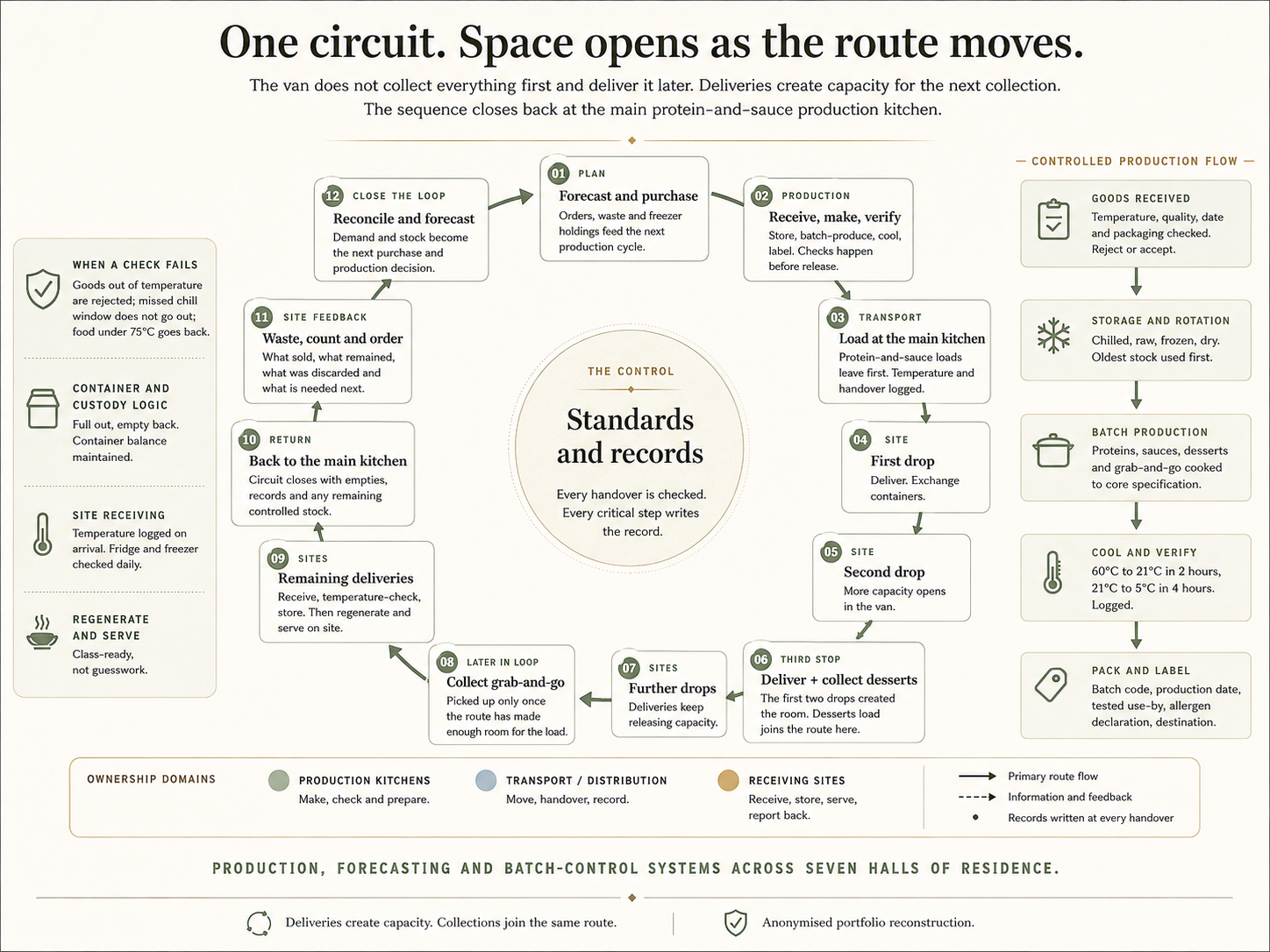
The recurring problem was rarely a lack of effort. It was unclear information, fragmented ownership and too much dependence on experienced individuals remembering everything.
Sec. 01
Context and operating scale
The Victoria University of Wellington contract, run across seven halls of residence with three production kitchens, 5,000+ daily covers and 100+ staff across the operation.
The sites ranged from high-volume refectories to retail outlets and event catering, each with different volumes, service windows and expectations, all fed from central production.
From the outset the role also covered events delivered across the wider sector, beyond the contracted scope.
Sec. 02
The real problem
At this scale, individual expertise is not enough. Skill that lives in one head cannot cover seven halls of residence on a Tuesday morning.
The starting condition was seven halls of residence each cooking independently — seven versions of the same menu, seven standards, no shared visibility, and no way to see what was actually happening across the operation until service was already under way.
The operation needed production forecasting, clear responsibility, procurement alignment, consistent SOPs, traceability, allergen controls, reliable information between sites and central production, and a way to see batch and volume requirements before service was affected.
Sec. 03
My role
- Contributed to production-flow mapping
- Contributed to SOP development
- Supported HACCP-system alignment
- Carried out advanced forecasting and volume planning
- Supported financial mapping and cost rationalisation
- Managed multi-site daily production
- Established and maintained cyclic menus and operational standards
- Developed and implemented digital batch tracking and volume ordering
Sec. 04
What I designed
The core decision was to stop treating seven halls of residence as seven independent kitchens. Three became specialised production kitchens — proteins and sauces, desserts, and grab-and-go — producing for the whole operation by volume and requirement, rather than every site cooking its own version of everything from scratch.
The protein and sauce kitchen ran at real production scale, over a tonne of food a week, batch-prepping proteins in kilo lots and building sauces centrally. Concentrating that work in one location made it possible to use higher-skill, higher-yield techniques — equilibrium brining, slow cookery — that do not scale well when repeated across seven separate kitchens but scale very well from one. Batch samples were sent away for laboratory testing to verify shelf life, which both validated the process and extended the usable window of what central production could hold.
The grab-and-go kitchen ran up to around a thousand items a day at peak — a packed salad daily, sandwiches and wraps, juices and smoothies — with the dessert kitchen carrying university dessert production alongside additional grab-and-go lines.
The split was not arbitrary. Central production held what benefits from batch scale and technique — proteins, sauces, desserts and the packaged grab-and-go lines — and very little of that was duplicated at site level. What stayed local was what has to be fresh, fast or made to order: vegetables and starches, the composed salads and salad bar, the sandwich station, and later the smoothie stations. A small number of dishes were also retained on site to balance load away from the protein and sauce kitchen. Sites finished what arrived rather than receiving it complete.
The salad bar was treated as an offer in its own right rather than a garnish table. It ran all day to a written specification — grains, beans and pulses, proteins, vegetables, toppings and dressings — so a guest could either use it to complete a main meal or build a balanced plate from it alone. That mattered most for anyone the hot specification did not serve well on a given day, and it meant the composed element of the offer did not depend on the central kitchens at all: it was built and replenished on site, dressed late and held cold.
Transport was treated as part of the production system rather than an afterthought, because a chilled batch that arrives untracked is not a controlled batch. A refrigerated in-house van ran one daily circuit rather than collecting everything first and delivering it later. It started from the main protein-and-sauce production kitchen with the first load, made two early deliveries, and used the space those drops created to collect desserts at the next stop. Further deliveries opened more capacity; the grab-and-go load joined later in the same circuit once there was room for it. The remaining deliveries followed before the van returned to the main kitchen with empties, records and any remaining controlled stock. Gastronorms and containers were exchanged one for one at handover, full out and empty back, so returnable stock stayed in balance. Sign-out, sign-in, goods-received checks and temperature logging made custody and condition visible at the handovers rather than assumed in transit.
The digital tracking and ordering layer linked individual sites with central production. Rather than adding a reporting burden, it made the information each site already held visible to the people who needed it upstream.
The design intent was narrow and deliberate: make the next correct action visible, and make the current state of a batch answerable without a phone call.
- Three specialised production kitchens — proteins and sauces, desserts, and grab-and-go — replacing seven independent ones
- Batch protein and sauce production at over a tonne of food a week, using yield-focused techniques concentrated chefs could apply consistently
- Laboratory shelf-life verification on batch samples, validating the process and extending the usable holding window
- Grab-and-go production at up to around a thousand items a day at peak, with dessert production alongside
- Deliberate on-site production retained to balance load away from the main production kitchen
- An in-house van fleet on scheduled runs, sized against each site's ordered volume
- Sign-out and sign-in at both ends of every movement, with goods-received checks and temperature logging at each handover
- More accurate forecasting against real site demand
- Stock visibility across locations
- Clearer procurement decisions
- Improved production accountability
- Easier coordination between central production and delivery sites
Sec. 05
How it was used
The systems ran inside normal daily operation rather than alongside it. Cyclic menus set the rhythm; forecasting and volume ordering set the quantities; batch tracking recorded what actually happened.
Traceability and allergen management were operational requirements, not optional additions, so the records had to be produced by the work rather than reconstructed afterwards.
Centralising production only pays off if what arrives at the receiving site can be regenerated and assembled correctly without central supervision — that final-mile problem is a system in its own right, covered separately.
Sec. 06
The operation, drawn
Two views of the same contract: the circuit that moved food between kitchens, and the offer it existed to serve. Both are drawn from the operation as it ran; no employer document is reproduced.

Sec. 06b
How the results were recognised
The operational and financial data behind this work belongs to the employer and is not published here. What can be stated is what followed.
During this period I held Executive Chef responsibility for the seven halls of residence operation and built the batch tracking and regeneration systems described above.
From the outset I was delivering events across the wider sector, beyond the contract I was hired onto. That brought two Star Awards in 2024 — Chef of the Year in June and a Performance Award in November — and in December, promotion to Culinary Development Lead: a national role covering Forsyth Barr Stadium, Massey University at Albany and Palmerston North, VUW, and schools and corporate contracts nationally.
These are decisions other people made. They are offered as evidence that the work was judged to have worked — not as a substitute for the measurement discipline described below, which is a separate thing and still the right thing to build in from the start.
Sec. 07
Relevance by outcome
Recognition
- Multiple contract renewals contributed to at sector level
- UniLodge Canterbury tender — culinary offer and menu designed, client presentation cooked
- Promotion to Culinary Development Lead, December 2024
- Chef of the Year · June 2024
- Performance Award · November 2024
Financial relevance
- More accurate planning and procurement
- Improved visibility of production requirements
- Lower risk of overproduction and emergency purchasing
- Clearer staffing and preparation decisions
Compliance relevance
- Food-safety traceability and allergen management operational throughout
- SOP and HACCP alignment supporting repeatability
- Records generated by normal work, supporting audit readiness
Employee and customer relevance
- Clearer expectations across multiple teams
- Less reliance on verbal handover
- More consistent delivery across diverse client sites
- Capacity to support stadiums, schools, universities, banks and corporate clients
Sec. 08
Evidence ledger
Each statement on this page sits at one of five levels. Measured means recorded and quantified at the time. Documented means a retained artefact or record exists. First-person account means it rests on Ciarán's own testimony with no external corroboration. Inferred means it is reasoned from the design rather than shown by data. Not claimed means the page is explicitly not asserting it, and says why. Nothing is published above the level its evidence supports.
Operating scale: seven halls of residence, three production kitchens, 5,000+ daily covers, 100+ staff across the operation.
Dishes developed for mass production at a 100,000-meals-per-day facility, entered into circulation.
A separate facility, in the national role. Not the seven halls of residence operation described here.
Development and implementation of digital batch tracking and volume ordering.
Three of the seven halls of residence were converted into specialised production kitchens — proteins and sauces, desserts, and grab-and-go — feeding the remaining sites, rather than each site cooking independently.
The protein and sauce kitchen ran at over a tonne of food a week; the grab-and-go kitchen ran up to around a thousand items a day at peak.
Chef-declared operational volumes, consistent with the scale of the wider contract. Not independently audited.
Batch samples were sent for laboratory testing to verify shelf life.
The testing was external. Reports are employer property and are not published; no specific shelf-life figure is stated here.
Central production covered proteins, sauces, desserts and packaged grab-and-go, with very little duplicated on site; vegetables, starches, salads, the sandwich station and smoothies were made locally. A small number of dishes were retained on site to balance load.
A refrigerated in-house van ran one daily circuit in which deliveries created capacity for later collections: the first protein-and-sauce load left the main kitchen, early drops created room for desserts, further drops created room for grab-and-go, and the route then closed back at the main kitchen. Returnable gastronorms and containers were exchanged one for one, with sign-out/sign-in and temperature logging at controlled handovers.
Route sequence corrected from the earlier simplified 'collect everything, then deliver' reconstruction. The public graphic remains an anonymised portfolio reconstruction.
That concentrating production in one kitchen produced a better yield than distributing the same techniques across seven kitchens.
The reasoning is stated; no yield figure is published, and the underlying data belongs to the employer.
Executive Chef at Victoria University of Wellington 2023–24, promoted to Culinary Development Lead in December 2024.
Contribution to the UniLodge Canterbury tender: catering design across three main sites and two satellite kitchens, culinary offer and menu design, revisions, and cooking the client presentation. Involvement ended at tender stage; no operational outcome is claimed.
Named because the tender is part of Ciarán's documented work. Scope is limited to tender and culinary design; no post-tender operating role or outcome is claimed.
Two Star Awards in 2024: Chef of the Year in June and Performance Award in November.
Financial mechanism — how better forecasting and visibility reduce overproduction and emergency purchasing.
Waste, cost-saving and financial-performance figures.
The underlying data exists but is the employer's property and is not published. No figure is stated here, and none should be inferred from the recognition above.
Failed checks stopped the batch: goods out of temperature rejected at delivery, cooling that missed the window not served, and any dish under 75°C returned rather than passed.
The all-day salad bar ran to a written specification — grains, beans and pulses, proteins, vegetables, toppings and dressings — so it could either complete the main meal or stand as a balanced plate on its own. Built and replenished on site, dressed late and held cold.
The halls ran a four-week menu cycle, repeated three times before replacement unless feedback required an earlier change.
Sec. 09
Reflection and next iteration
The results were recognised through a promotion and two Star Awards in 2024. What the operation did not capture was a clean before-and-after on waste, remakes or labour variance that I could carry out with me — and the data that does exist belongs to the employer, where it should stay.
So that is the first thing I now agree on any engagement: what will be measured, and who owns the resulting figures. It costs nothing at the outset and cannot be reconstructed afterwards.
Sec. 10